
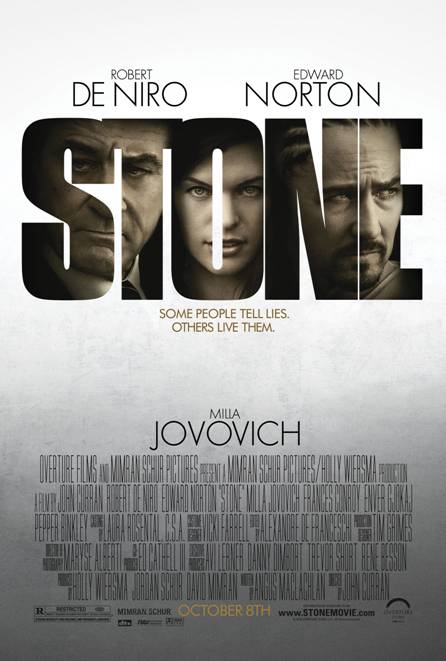
Two men sit awkwardly across from one another; you know
their faces well. One is a
Hollywood icon"”a man who has starred in some of the greatest movies ever made,
now reaching the age where most men would retire. Yet this individual is still a powerful figure, and despite
his age he is still very clearly in control of every situation. He is Jack Mabry, a parole officer who
has spent his life judging men for what they've done. Opposite him is one of
the great talents of the 1990s, an actor who has been everything from a
neo-Nazi to a superhero. He is not
in control; rather, he is vulnerable, dejected, and searching for purpose in
his life. Despite this emptiness,
his calculated mannerisms and subtle exploitations make him very
dangerous. He has seen and done
things that would break most people down, but he handles his burden with
ease. His name is Stone Creeson,
he is up for parole after eight years in federal prison, and he will do anything
to get out.
John Curran's latest film is a remarkable character study of
prison life and the parole process.
From very early on, it is apparent that nobody can truly be trusted in
this environment. Robert De Niro
plays Jack Mabry, a parole officer with a dark history of domestic abuse and
religious hypocrisy. Even though
he serves as the voice of the law, Mabry's own sins leave a tarnishing stain on
his entire persona. Edward Norton
portrays Stone Creeson, a felon who readily admits to his transgressions and
accepts them as an irreversible part of his life. Nevertheless, when the movie begins Stone is a squirrely
thug with a defensive attitude and distaste for everyone around him.
The issues of sex and religion set these men on a crash
course of magnificent proportions.
Curran explores the potential for hypocrisy within a deeply religious
population while simultaneously offering insight into the redeeming qualities
of faith and forgiveness. Stone
experiences a life-altering moment of spiritual enlightenment during the course
of the film; at first it seems as though his transformation is an elaborate and
misguided act designed to appease Mabry, but as the movie moves forward it
becomes clear that Stone is genuinely looking further within himself in search
of a higher power. Meanwhile, Stone's
sex-mad wife Lucetta is attempting to seduce Mabry into approving her husband's
parole. Milla Jovovich does a
magnificent job of exploiting the weaknesses of every character she comes into
contact with; her seductive smile always carries with it an air of sinister
intentions"”she may be the best thing in this film.
Ultimately, Stone's only failure is that it doesn't manage
to really go anywhere; it's a great character study, but not necessarily a
great story. Regardless, three
stellar performances by Norton, De Niro, and Jovovich all combine to create a dark
and gripping film about manipulation, betrayal, and the guilty consequences of
a misguided life. Certain aspects
of the Stone's events and character's
motivations seem to be intentionally ambiguous, and it's better that way. This type of thriller isn't typically
my cup o' tea, but I couldn't help but feel awestruck by the time the film's
credits started to roll. Stone may not be the most original story
every written, but that doesn't stop it from being a great film.


