
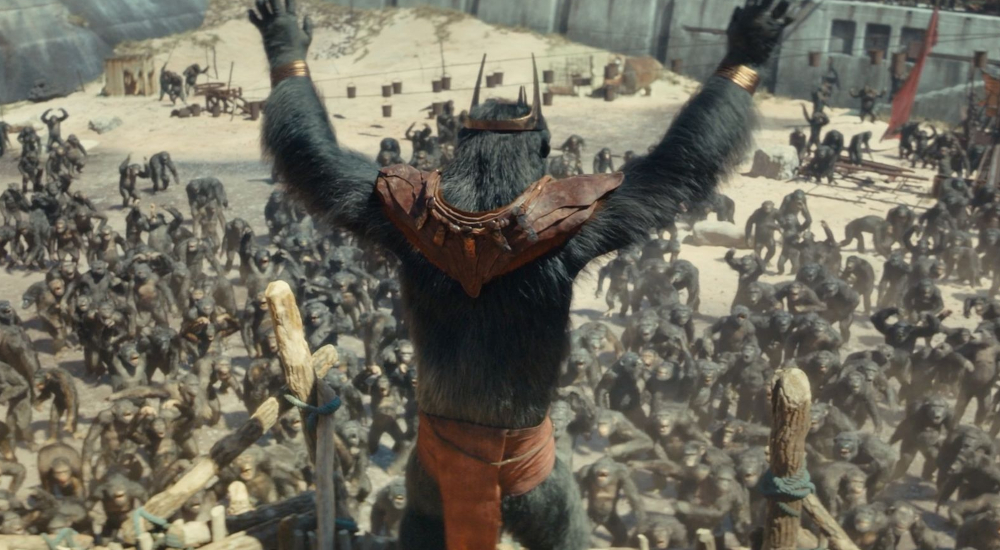
After a sharp, successful trilogy of reboots, it seemed there was nothing left to explore in the Planet of the Apes series. But director Wes Ball (The Maze Runner trilogy) and writer Josh Friedman (who has a strong resume of adapting movies for TV) have delivered a solid new story, one that proves there's still plenty of thrills and power in the conflict between man and beast.
Set hundreds of years after Caesar has died, apes rule the planet. Aside from a few scattered tribes of mute humans, it's only animals amongst the ruins of civilization. The main clan of apes commune with nature, and feel kinship with birds. The dangers of the natural world still exist, but their life is peaceful. But sightings of a woman (Freya Allen) and a brutal attack from a rival clan violently disrupt their lives.
Left for dead, Noa (Owen Teague) journeys to find his abducted family and friends, unsure of the dangers that lie ahead. This is all classic Hero's Journey stuff, but it's a credit to the creative team that you can't help but get caught up in the story. It's so filled with genuine emotion and moral quandaries and sweeping action that you forget these are just CGI apes.
The film's most fascinating character is easily Raka (Peter Macon), who teaches Noa about ape history and accompanies him for part of his sojourn. He is the last of the true believers in Caesar's teachings. His love and compassion stand in stark contrast to the evil king Proxima (Kevin Durand), who twists Caesar's teachings into hateful rhetoric. Using religion as a lure into fascism? Surely that could only happen in dystopian science fiction. As with Rise, the film's weakest link is its main human character. Allen (Netflix's The Witcher) certainly has captivating eyes, but she's a complete blank, and feels less like a human than her simian counterparts.
When Kingdom traverses the vast open spaces of America, it's incredibly compelling. But kept to the confined spaces of a prison in its last act, it loses a step. Thematically it's still provocative, especially in its exploration of wartime collaboration and prejudicial distrust of the "Other." Like the previous trilogy, this film does not have a lot of hope for humanity or apes who act like humans. Will that improve in a likely sequel? Probably not. But if it's as well-made as this one, I'll happily line up for it.